
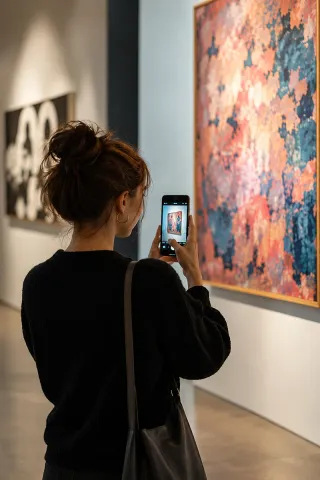
A new generation of art collectors is reshaping the relationship between artists, galleries and audiences. Younger buyers are researching artworks independently, exploring digital platforms and seeking a deeper understanding of what they collect. For artists, these developments open new possibilities for visibility and engagement — but also raise questions about how to present their work without compromising their artistic practice.
A changing generation of collectors
The Art Basel and UBS Survey of Global Collecting 2026, released on 8 October, offers new insights into younger collectors' behaviour.
Among 3,100 high-net-worth individuals surveyed across ten international markets, Generation Z emerged as the highest-spending generation for fine art. Gen Z respondents reported average expenditure of approximately $347,000 in 2025 — more than twice that of any older generation represented in the survey.
These figures require context. The study concerns wealthy people already active in collecting, not an entire generation. Nevertheless, the findings challenge the assumption that younger people lack interest in acquiring art.
Perhaps more interesting for working artists is not simply how much these collectors spend, but how they discover, research and choose artworks.
Discovery is no longer confined to the gallery
Galleries, dealers, exhibitions and professional recommendations have long played a central role in introducing artists to collectors. Those channels remain important, but they now coexist with a wider range of digital encounters.
The survey found that 58% of respondents used digital resources for collecting advice, while 32% cited Instagram or X as sources of recommendations.
An artist might first attract someone's attention through an exhibition photograph, an online article or a social media post. That encounter can lead to further research, a studio conversation, a gallery visit and sometimes a purchase.
For artists without established gallery representation, this variety of discovery routes matters. But visibility alone does not guarantee interest, and interest does not automatically result in sales.
The challenge is to create an accessible path from discovering an artwork to understanding the practice behind it.
Collectors are doing their homework
One of the strongest findings concerns independent research. Some 72% of collectors reported undertaking moderate or significant research before buying art. Among Gen Z collectors, the figure reached 80%.
Someone encountering an unfamiliar artist may want to explore earlier work, understand the artist's interests, review exhibitions and see how the practice has evolved.
A professional online presence can help. It need not be elaborate: a carefully selected portfolio, a clear artist statement, relevant biographical information and a means of contact offer a useful starting point.
Just as importantly, the presentation should reflect the character of the artwork. Artists do not need to adopt an artificial online persona or produce promotional content constantly. Clarity and consistency can be more valuable than constant activity.
The value of a personal connection
People collect art for many reasons: visual appreciation, emotional resonance, intellectual curiosity, identity and the pleasure of living with a meaningful object.
In the 2026 survey, uniqueness and rarity were the most frequently cited priorities in art ownership, selected by 43% of respondents. This preference was particularly strong among Gen Z collectors.
For artists, this underlines the difference between communicating the value of a work and simply advertising its availability.
A glimpse into materials, ideas or artistic decisions can deepen the audience's understanding. A studio photograph, a short reflection on a technique or an account of a work's development may reveal something not immediately apparent from the finished image.
That context should complement rather than overwhelm the work. Art does not need to surrender all its ambiguity to become accessible.
New opportunities, but not without challenges
Younger collectors appear more open to unfamiliar artists. In the survey, 56% of Gen Z respondents reported buying work by a newly discovered artist, compared with 36% of Baby Boomers.
There is an important counterpoint: the share of all respondents who bought work by newly discovered artists fell to 45%, its lowest level in five years. Research does not necessarily mean buyers are taking more risks.
Digital discovery has expanded the potential audience beyond an artist's immediate geographical or professional networks. Yet competition for attention is considerable, and an online following is not the same as a sustainable artistic career.
Exhibitions, personal introductions, studio visits and relationships with galleries and cultural organisations still matter. Rather than treating online and offline engagement as rival approaches, artists can consider how one reinforces the other.
What can artists take from these developments?
Make your work easy to discover. Maintain a coherent portfolio and ensure that someone encountering your work can find reliable information about you.
Provide context without overexplaining. An artist statement, selected process images and exhibition documentation can offer meaningful insight while leaving space for interpretation.
Think beyond individual platforms. Social media may introduce your work to new audiences, but your own website or independent professional profile provides a more stable point of reference.
Make engagement possible. Clear information about exhibitions, available work and professional contact can help turn curiosity into a conversation.
Stay connected to physical art experiences. Exhibitions, studio visits and direct encounters remain essential to building lasting relationships.
None of this requires artists to become full-time marketers. The goal is to make their practice understandable and accessible to people who are genuinely interested.
Technology is changing discovery, not the value of art
The survey also found that use of apps and AI tools for collecting advice rose from 4% in 2024 to 22% in 2026.
As digital search and AI-assisted recommendations become more common, accurate descriptions and clear documentation of artworks may become even more useful. Yet technology cannot replace the experience of standing before a work, encountering its material qualities or developing a personal response.
These tools may influence how someone finds an artist. The lasting relationship with the work is another matter.
Looking ahead
The rise of younger collectors is not simply a story about social media. It reflects broader changes in how people encounter culture, establish trust, research creative work and develop relationships with artists.
For emerging and established artists alike, the opportunity lies in making their work easier to encounter without letting the demands of visibility dictate what they create.
The question is no longer only where an artist exhibits, but also how their practice can be encountered, understood and remembered beyond that exhibition.
Artistic integrity and professional visibility need not be opposing priorities. A thoughtful approach to both can help build relationships that extend well beyond an initial online encounter.